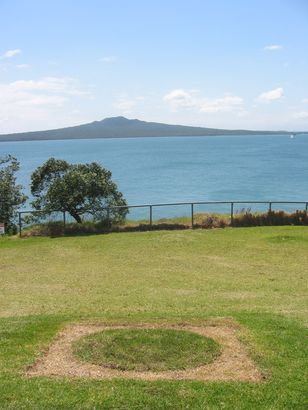
Situated at Fort Takapuna above a concealed WWII artillery store, Grass Roots operates as a surface intervention over latent architectures of defence. Presented within NZ Sculpture Onshore—an exhibition supporting refuges for women and children escaping domestic violence—the work reorients attention from public fortification to protection within the private sphere.
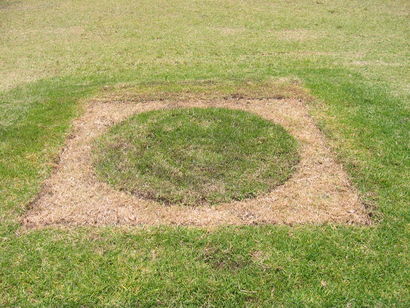
A square incision frames a circular field of living grass, establishing a calibrated tension between geometric order and organic growth. The circle—traditionally associated with continuity, nature, and the feminine – sits within the regulating logic of the square, with its more ordered and masculine inflections. Initially contained, the inner lawn is synchronised with its surroundings, yet its condition shifts as the exposed perimeter—roots, soil, and cut edge—thickens, spreads, and gradually encroaches.
Over time, containment gives way to infiltration. The centre is not secured but slowly diminished, as the margins assert their own agency. In this gradual reversal, boundary becomes pressure point, and enclosure becomes a site of exposure and transformation.
"Grass roots” relays origins, habitation, and collective mobilisation. Here, it functions as substrate and metaphor: a living system in which force gathers at the edges, and change begins from the ground up.