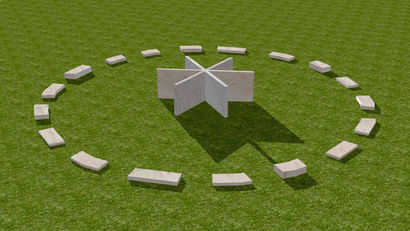
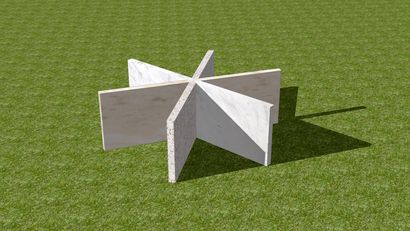
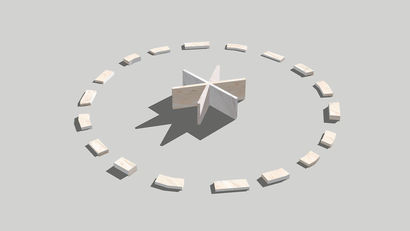
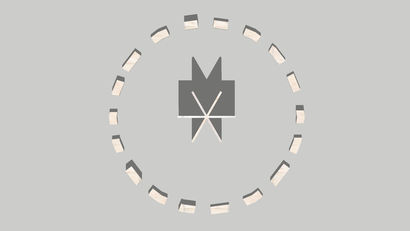
At the entrance to new sculpture parklands on Cadigal and Kameygal land, Asterisk sets a stone marker and placeholder within a landscape being reshaped by major transport infrastructure. Formed as a star, compass, and crossing point, the sculpture is oriented toward Ginan, the smallest star in the Southern Cross, now internationally recognised by its ancestral Aboriginal star name.
The title Asterisk derives from the Ancient Greek asteriskos, meaning “little star”. Its classical reference is held as a trace, while the asterisk symbol (*) marks omissions in the received languages of star-navigation and ancestral passage. Through celestial geometry, stone memory, and directional encounter, the work’s intersecting planes and shadows register presence and absence, opening a charged relation between earth and sky, movement and displacement, navigation and return.
Carved from three distinct stones drawn from different edges of the Australian continent, Asterisk brings together materials shaped across vast geological time. Its anchoring plane is formed from a rare sandstone discovered deep below the site during construction of the new transport tunnel. Salvaged by the artist and reformulated as a new composite, this “tunnel-stone” carries the memory of land opened, extracted, and transformed to forge new passages through the city.
Set against stones from the Far North and Far West, the tunnel-stone surfaces the memory of the bedrock beneath, while its starward orientation points to the skies. Visible from the human-made thirty-metre mound at St Peters Interchange, the sculpture casts shifting shadows within a circle of heritage road blocks, also recovered by the artist from local roads lost to the new route. Activated by sun, season, and passage, Asterisk traces change and marks new directions, holding land, stone, and sky in a stratified field of encounter.