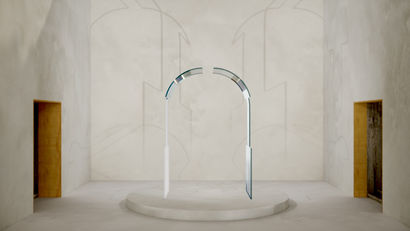
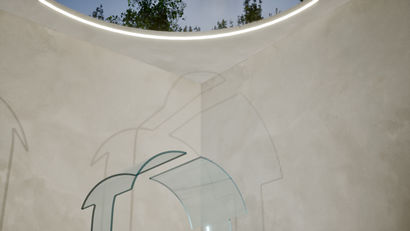
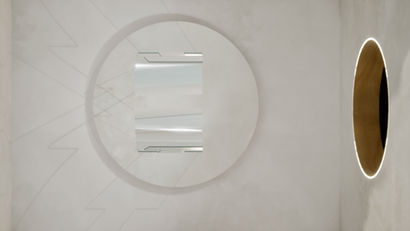
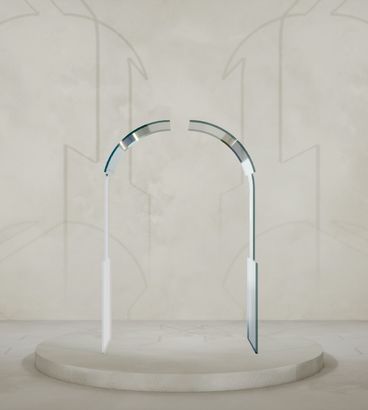
In virtual reality, The Bell Jar interrogates the soma and psychology of Other and Self. The large-scale installation is experienced within Archai Virtualis, a virtual museum built by its curators to Vitruvian principles which promote (inter alia) the perfect proportions of Renaissance Man. Inside that larger frame, the artist scripts The Bell Jar as its own room: sculpting domed proportions, arched apertures, and a circular oculus that choreographs the arc of sun and moon. In VR, this room feels like a womb–fluid, enclosing, and warm–while the classical ethos conjures the authority of Greco-Roman structures and architectural lore.
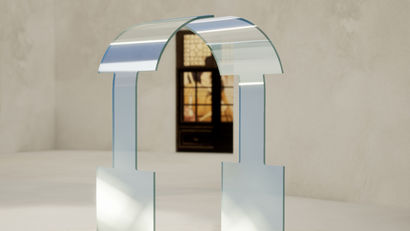
Across the virtual membrane of VR, the sculptural form becomes another translucent membrane between the seen and unseen, hovering at the thresholds of psychic encounters, surreal apparitions, epiphanies, and dystopian dreams. At the centre, two crystal-glass figures rise from a circular concrete pedestal, arching inward in parallel and perfect harmony. Autonomous and precarious, they lean in to the point of breaking, bowing but never touching. Frozen in a balletic pas de deux, the figures crystallise the tension between yearning bodies, as if the pandemic logic of physical distancing infiltrated the virtual sphere. The sense of entanglement is deepened by the title, drawn from Sylvia Plath’s iconoclastic novel The Bell Jar (1963), which probes a free-thinking woman’s struggle with alienation and insanity. In this vein and beyond, the work holds invisible structural constraints up to the light, while opening euphoric avenues for escape.